Sunday, July 21, 2013

Inside Global Pagoda.

An afternoon spent at the Global Vipassana Pagoda. There were so many things to learn. 

Planning for the construction of the Global Vipassana Pagoda began in 1997, while actual building work started in 2000. The pagoda consists of three sub-domes.  The external diameter of the largest section of the dome is 97.46m and the shorter sections, is 94.82m. The internal diameter of the dome is 85.15m. The inside of the pagoda is hollow and serves as a very large meditation hall with an area covering more than 6000 sq m (65,000 sq ft). The massive inner dome seats over 8000 people, enabling them to practice the non-sectarian Vipassana meditation as taught by Mr S N Goenka, and now being practiced in over 160 centres in more than 60 countries.

The pagoda is ready, but the environment is still under construction.  The story of every project ! 


Doors on four sides, below the central dome. This is a view of one set of doors leading to the meditation hall, open only to those who have done the 10 day meditation course.


The workmanship on the ceiling in the entrance area  before the doors .


A closeup of the huge doors to the meditation room


Closeup of the intricate work on the ceiling


Including around the supporting pillar.....


The structure opposite to the main Pagoda.  The pagoda consists of three sub-domes. The first and largest dome was completed when bone relics of Gautama Buddha were enshrined in the central locking stone of the dome on October 29, 2006, making it the world's largest hollow stone masonry structure containing relics of the Buddha.


Rising to heavenly heights


Welcoming you with great humility...


Looking out towards the main entrance from inside. The blue of the tarpaulin required in the heavy monsoons...


 This gong  stands opposite the huge bell pictured later ....


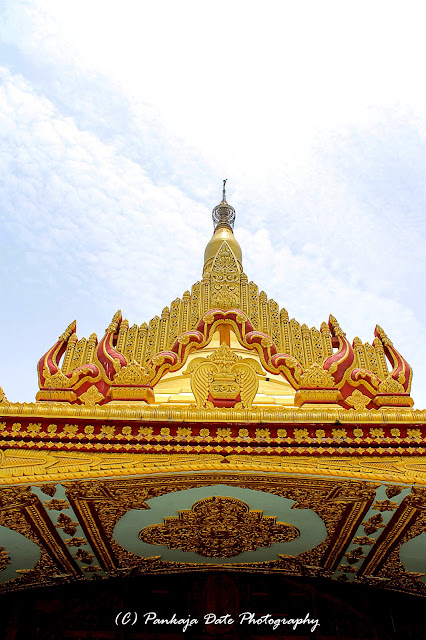
Detailing above the entrance to the meditation room doors


This massive bell may be rung with the wooden log piece  on the floor near me .


The center of the Global Vipassana Pagoda contains the world's largest stone dome built without any supporting pillars. The height of the dome is approximately 29 metres, while the height of the building is 96.12 meters, which is twice the size of the previously largest hollow stone monument in the world, the Gol Gumbaz  Dome in Bijapur, India


Rear View of the Gong

This is what you see at the main entrance before you approach the dome , where the relics are kept.  Inscriptions pertain to teachings of the Buddha.

Saturday, July 20, 2013

Crossing to the Pagoda.

The Global Vipassana Pagoda is a Meditation Hall near Gorai, in the northwestern part of Mumbai. It is built on donated land on a peninsula between Gorai Creek and the Arabian Sea. 

The pagoda is to serve as a monument of peace and harmony. The Global Vipassana Pagoda has been built out of a sense of  gratitude to the Buddha, his teaching and the community of monks practicing his teaching. Its traditional Burmese design is an expression of gratitude towards the country of Myanmar for preserving the practice of Vipassana. The shape of the pagoda is a copy of the Shwedagon Pagoda in Yangon, Myanmar. It was built combining ancient Indian and modern technology to enable it to last for a thousand years

I went last Sunday to visit this Global Pagoda on Mumbai's western coast line. A bus ride to Gorai creek and then rushing on to the ferry that took us across the creek en route to the Pagoda. Once off the ferry, there are two roads one can take. One takes you to the Esselworld  Entertainment Park , and the other takes you to the Pagoda. 

Fifteen years ago, I might have taken the first road.  This time , I took the second.

This is a place  of holy pilgrimage ....

This is the first of a two-part post......


The route to reach the ferry.


 Fishermen's boats  all tied up across the creek.


 The Pagoda from a distance.


Another boat tied up in solitary splendour at the shallow end.


Fishermen go fishing in these kind of small boats


 Folks crowded on to the  ferry takes the general public to the other end of the creek.


 An approaching boat coming from the pagoda side, on a return trip.


Rushing  to the Mainland


 Clicked from the boat's bow (front side).


 A beautiful caterpillar also seeking something golden


 A statue of Buddha at the entrance of the Pagoda.


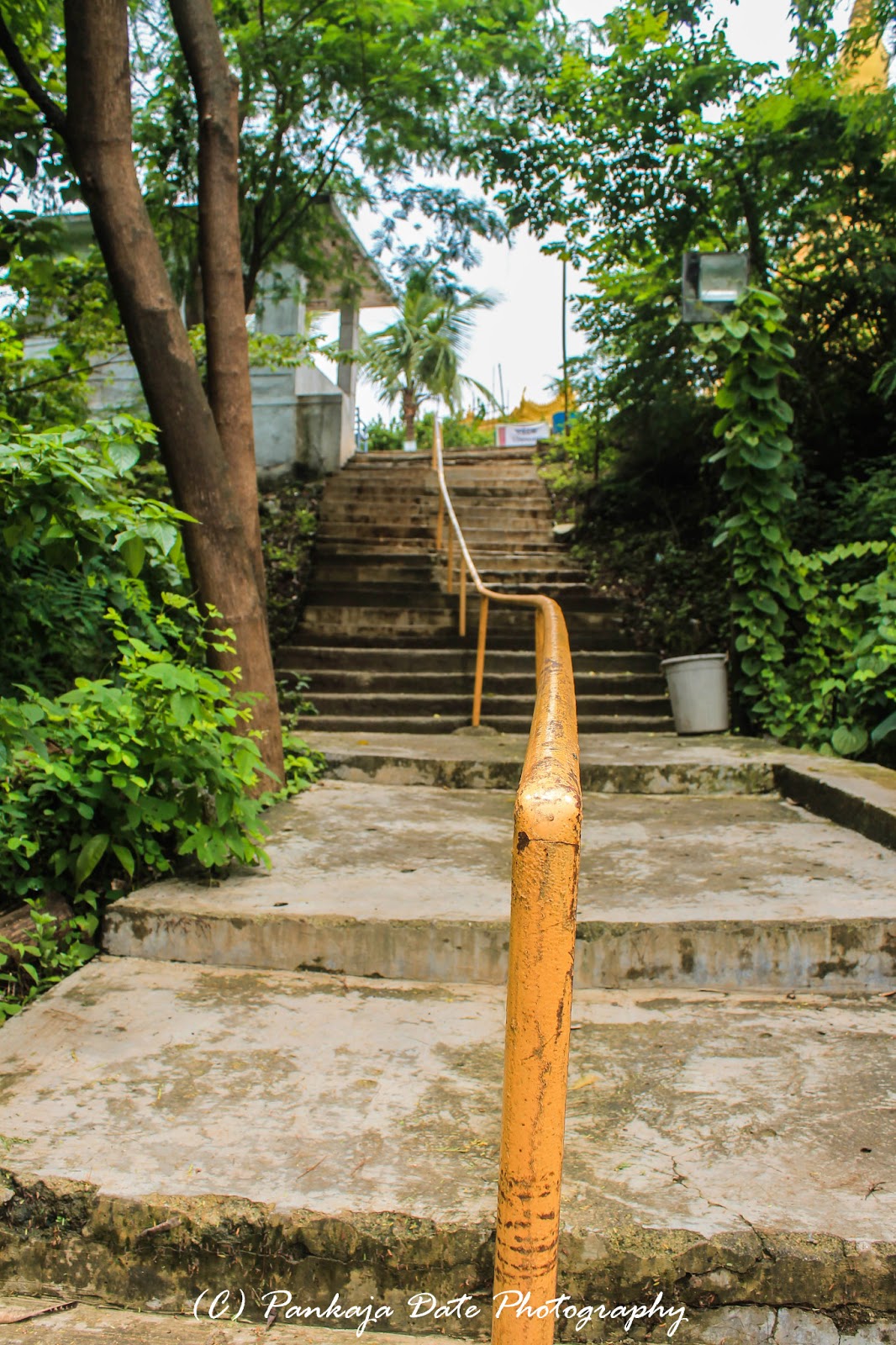
 The path to enlightenment (which leads to the Pagoda).

Stay tuned for part II.....

Sunday, June 30, 2013

Monsoon & More....

The southwest monsoon, arrived earlier than expected this year, and almost immediately there was a quiet change of color in the environment. 

These photos have been clicked exclusively on the campus where I live.

A typical road on our campus, with the trademark GulMohur trees lining the sides.


A closeup of a wet leaf of the Bramhakamal plant, currently growing in my balcony.


One more closeup  of some more willful leaves of the Bramhakamal plant


This is what you get when your window overlooks an entire canopy of green, and you click from inside , with the window closed during a particularly strong shower...


At the western edge of our campus, at the promontory, just outside the garden...


Refreshed after the first big rainfall.  This fluorescence that I clicked at the top of an old tree  which is almost 5 storeys high itself, and probably predates our campus.


Once again, drops sliding and falling off into oblivion, from the window grill bars of my house.


The brilliance of the Gulmohur bloom


New rains, new life ...


Standing tall amidst the green: a natural Qutub Minar


My faithful bicycle, being admired by some clouds


Sunset skirmishes in the sky


This is not, someone with wet hair , looking at the lake.  But an old tree, laden with these "swinging" roots, enjoying a lakeside evening, just before the clouds discharge in torrents.... 


Wednesday, May 22, 2013

Sunday at the Gateway


A Sunday evening in May 2013 spent at the  Gateway of India,  in the Mumbai Harbour.  Stately old buildings, the Iconic Taj Mahal Palace and Towers Hotel, and the millions of Mumbai, who visit this area and go back with so many memories.

There is history, there is "current events", there is the sea dashing against the rocks, and the thousands who come, some to visit, some to gape, some to play, some to eat, some to earn a living, and some , like me, to click.....

The Cathedral of the Holy Name , in the Vicinity of The Gateway Of India, Mumbai.


Hope the Lord is listening to the prayers and pleas of the devotees....


The Gateway of India as it was possibly seen  in a side view, by various British royalty who arrived by sea, in the pre Independence days. It was built to commemorate the visit of King George the Vth and Queen Mary to India, in 1911. 


Today, the concourse of the Gateway, is a haven for tourists, children, vendors of touristy trinkets, and photographers who guarantee you a  keepsake photo in 10 minutes.   Some pigeons also visit, thanks to the abundance of bird food strewn around by those, who think, that like royalty, the pigeons too, must be welcomed.


With that load of balloons, he still has time to feed the pigeons. 


 Doesn't matter if you are not royalty ; the gateway is also for flag bearers who rush around in half pants  having the time of their lives.


Then there are those vendors selling soap bubble stuff at the Gateway. I bought some too, and couldn't resist clicking this .....


  And this .  Sunday evening multitudes at the Gateway of India....


The newer Towers section of the Taj Mahal Palace and Towers.  Back in its imposing avatar after the ghastly terrorist happenings of Nov 26, 2008.  The Taj faces the sea , and this is the concourse between the Gateway and the Taj. 


The actual Gateway of India viewed from Land... amidst the Sunday crowds.


The amazing structure and latticework.  The architect George Wittet designed it using a combination of Hindu and Muslim styles.  The arch is Muslim in style, while the decorations are Hindu.  Built from yellow basalt and concrete. The stone was locally sourced, while the perforated screens were brought from Gwalior .


The central dome is 48 feet (15 metres) in diameter and 83 feet (25 metres) above the ground at its highest point.


The original Taj Mahal Palace Hotel to the left, with the Towers section on the right.


The spectacular Taj Mahal Palace hotel as seen  from the Gateway of India,  approaching sunset, on a Sunday evening.  The visible frontage suffered the maximum damage in the terrorist attacks of Nov 26, 2008.  The Hotel now houses a memorial to those who lay down their lives in the course of doing their duty on that day.